Yeki bood, yeki nabood.
My five-year-old son’s eyes widen when I say these words at bedtime, signaling the beginning of a story that I make up on the spot. Stream of consciousness storytelling is difficult for me to do in Persian, as someone who’s lived in the United States her whole life. But this is how my father used to tell us bedtime stories. “Plants, animals, or humans?” he’d ask me and my sister. We’d choose a topic and he would soothe us to sleep with a magical, morality-driven tale of his own invention.
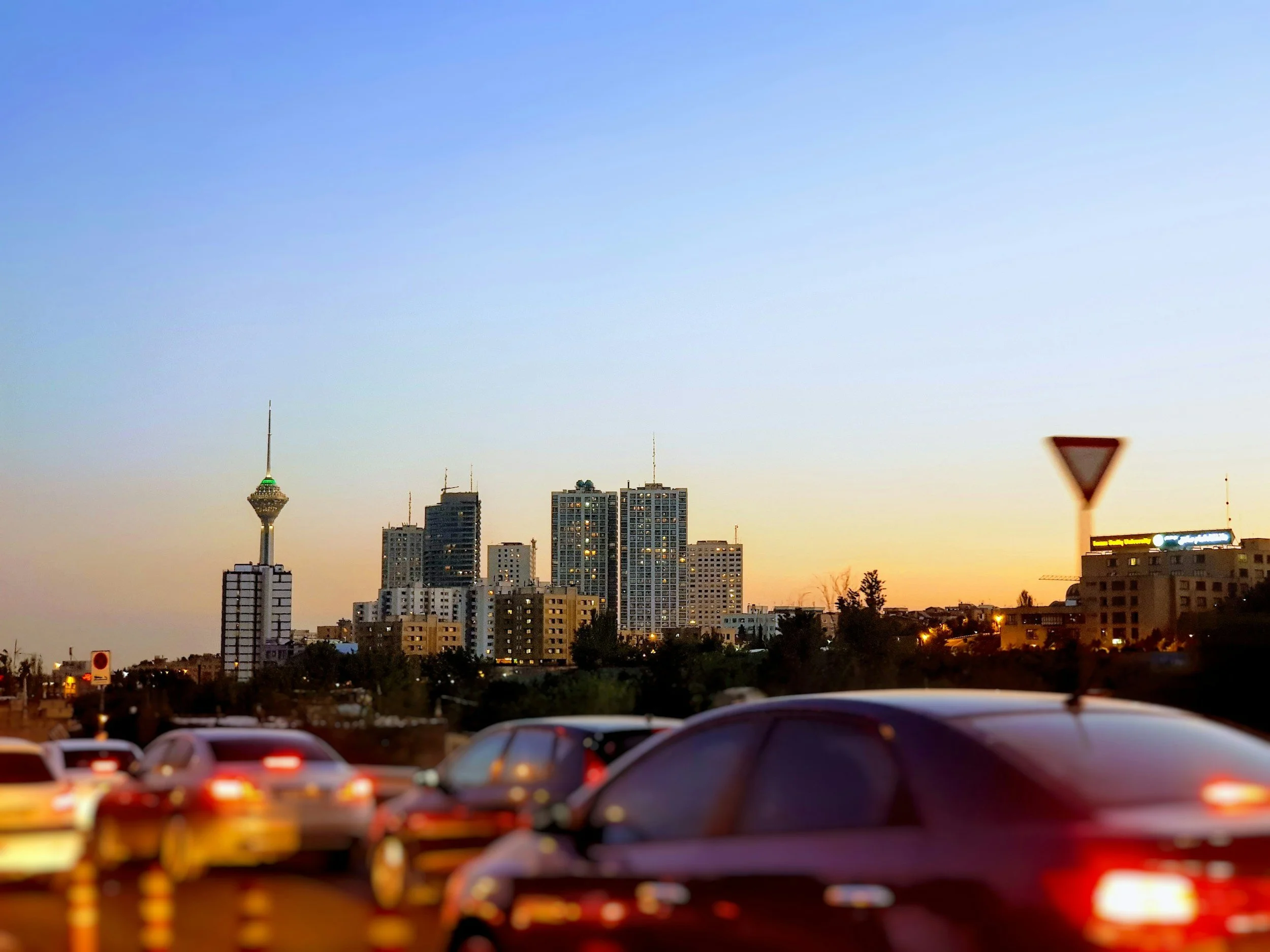
Most nights, I find a theme from my son’s day—tasty desserts, the anxiety around starting a new school, plans for the weekend—and I come up with a story that reflects and makes sense of his feelings. Tonight, we slip into a dream that I’ve created for us, flying freely across borders and oceans, toward a place we came from. We land in Tehran and step into the city’s vibrant center, weaving through pulsing streets, until we make our way to the bazaar. I buy him a cup of lemon faloodeh and, together, we visit the small toy stands and gift shops one by one.
Yeki bood, yeki nabood. The traditional Persian opening to a story or fairytale translates to “one was, one was not.” Existence and extinction, fact and imagination become simultaneous companions—two realities unfolding at once. We are here in his bedroom, my son and I. And we are elsewhere—in a faraway dream or in a memory passed down through generations. The distance between the two states collapses. In each one, there is truth.
“I want to stay here, in this scene that fades in and out in my mind. I want to reconstruct it, repaint the edges that have dulled, replay conversations I can’t remember.”
My son falls asleep and I tiptoe out of his bedroom. But I haven’t left the story. I am still suspended in Tehran, lost among family members and loved ones at my paternal grandparents’ home in the neighborhood of Tehran Pars. When I first visited Iran with my family at the age of nine, we spent most of our time at that house. Today, its doors open in my mind to an ever-expanding memory, each floor vibrating with footsteps that belonged to people who have since scattered to other neighborhoods, to other countries, to the afterlife. There we are enjoying a large family dinner, falling asleep beneath mosquito nets, drowning in the overwhelming joy of each other’s company.
I want to stay here, in this scene that fades in and out in my mind. I want to reconstruct it, repaint the edges that have dulled, replay conversations I can’t remember. As I get older, Iran feels increasingly out of reach—battered by U.S. or Israeli bombs, suffocating under sanctions, or imploding beneath the weight of its own brutal regime. I fear that my memories are not enough, that they lack the clarity I need to shape the story I want to one day tell my children. A story that cannot be confined by the structured hours before bedtime. About what we are made of, and the thread that connects us to what was and what will be.
*
Dozens of shoes clutter the foyer of my grandparents’ house in Tehran Pars. Inside, my aunt is boiling water for tea as voices overlap in the adjoining entrance hall. My cousins tear through the hallway to the small courtyard garden outside, where my grandfather’s fig tree emerges majestically from the weathered clay tiles. An uncle calls them back inside to wash up for lunch. One by one, my family members filter into the living room, which seems to be in a perpetual state of being made and remade for meals, a spread of colorful dishes laid out on the rug, then eventually cleared. Someone arrives to a chorus of greetings, while another is halfway out the door.
Time moves slowly inside, stretched by afternoon tea and jetlag-induced naps in the front guest room, the sound of a fly slamming into the grimy glass of the window, the voice of a street vendor yelling about fresh tomatoes outside. Beyond its walls, I remember glimpses. Dusty, cracked sidewalks. Storefronts shaded under sun-faded awnings. The spirited dialogue of neighborhood kids playing soccer in the alley, a purple striped ball bouncing out of view, and the sound of its splash as it falls into the open sewer lining the street.
Before Tehran Pars, there was the white light of the arrivals hall at Mehrabad Airport. A wave of familiar faces rushed toward us, and we crashed into it—a jumble of arms, perfume, and laughter locked into a bittersweet embrace. It had been 10 years since my parents and sister had gone back to Iran, a long-awaited return that was continually delayed by their insufficient finances and lengthy U.S. immigration process. In all the chaos of our arrival, I remember my maternal grandmother, my Maman Bozorg, most clearly. Her eyes wet, her arms reaching toward me, her body warm and safe. I felt I knew her, an imaginary relationship forged by my mother’s memories, though we had never met before that moment.
*
I am a mother of two sons. The eldest listens to my stories. The other finds comfort in my arms.
He, my youngest, is almost as old as the latest genocide Israel has been committing in Palestine. I measure its relentless passage by recalling his exact age. At lunch, mouth full of rice and khoresht, he laughs and mimics the circular “Wheels on the Bus” motion with his arms. A warmth swells within me, as my son’s dimpled hands reach for his spoon. It is an emotion I have learned to balance against another that feels impossible to define. The one that accompanies images of premature babies left to die in the NICU, their tiny limbs resting at their sides; of young children the same age as mine, bloody and lifeless on hospital floors. My son asks for more food, and I fill up his bowl, teasing him for his insatiable appetite. A 12-year-old boy in Gaza pleads for flour, shoving a fistful of sand in his mouth in frustration. In the occupied West Bank, a burst of Israeli gunfire pierces a Palestinian family’s car, killing a seven-month-old child, the same bullet wounding his parents. The more my son grows, the longer Palestine’s suffering. I have spent his entire life holding these scenes in my mind, each one a reminder of the world I do not want my children to inherit.
There are individual stories and faces that will never leave me, and I am grateful for the persistent grip they have on my memory.
Later, at my parents’ house, where Maman Bozorg now lives, I arrange two clear glass teacups on a tray and fill them with hot, honey-colored black tea. I set a bowl of dates next to Maman Bozorg’s cup and carry the tray to the dining table where she’s seated, her scarf pulled forward like a canopy, a shield against the bright sunlight pouring through the back patio doors.
She takes a bite of a date and tells me that her family used to make bread with the pits. I see the 12-year-old boy’s furrowed anguish, feel the grit of sand between his teeth.
Maman Bozorg grew up in the village of Ruteh, north of Tehran. As a child, she recalls feeling grateful for the rain, when the water level in the nearby creek would rise and she and her family could bathe and drink water. During World War Two, the British had occupied a neutral Iran in an effort to secure supply lines to the Soviet Union, bleeding the country of its resources and diverting food and aid from the civilian population. The result was a catastrophic famine, the country’s third in the span of 75 years.
Much of the food Maman Bozorg’s mother managed to come by then was riddled with dirt, refuse, and insects. I think of my son’s heaping bowl of rice, his endless requests for snacks even after he finishes his meals. And then of the mothers in Gaza, of the words they must find to explain the world’s moral failing to a child, of the final meals they must stretch into many, until there are none.
After two years, the famine in Iran had killed up to four million people—whether by starvation or disease. Many of Maman Bozorg’s close relatives, including her brother’s wife and her eldest sister’s infant daughter, were among the dead. She names them, as if summoning them to the table, shutting her eyes so tightly I worry that she is in pain.
The history of colonial violence is long, but we are rarely taught its full scope. I am consumed by these histories that repeat, the imperialist destruction that spreads without bounds, the connected realities we ignore and why. In Gaza, in Iran, and in Minneapolis; in detention centers and in over-policed streets in the United States and in occupied Palestine, the same vicious machinery moves, the same calculus that deems Black and brown bodies as disposable applies. We are not meant to see the linkages across time, peoples, and borders. We are not meant to recognize how wars begin, how they are seldom the work of one leader or political party, but rather the culmination of years and decisions across multiple administrations. We are not meant to notice the patterns that keep the past and present entwined; or our own complicity in the systems that want to destroy us. Because if we were all unified in this understanding, the institutions that thrive on our ignorance might lose their hold.
Maman Bozorg brings the final shaky sip of tea to her lips and I can sense the fragility of the stories that have survived. Her fingers tremble as she lowers the empty teacup on its saucer with a tiny clink. I reach over and pick it up. It is still warm, the heat of palms I have held and of lips that have kissed my cheeks. I walk it over to the sink, wrapping my hands around the glass, afraid that it might slip and shatter.
*
On every trip to Iran, I enjoy getting lost in the Tehran Pars house, always overflowing with people, knowing that I am never truly lost. During a family gathering, I quietly recite the names of my relatives, as if committing them to memory, unsure of when I’ll see them again. When I think I have accounted for them all, a distant cousin lifts me up in her arms and asks, “Do you know who I am?”
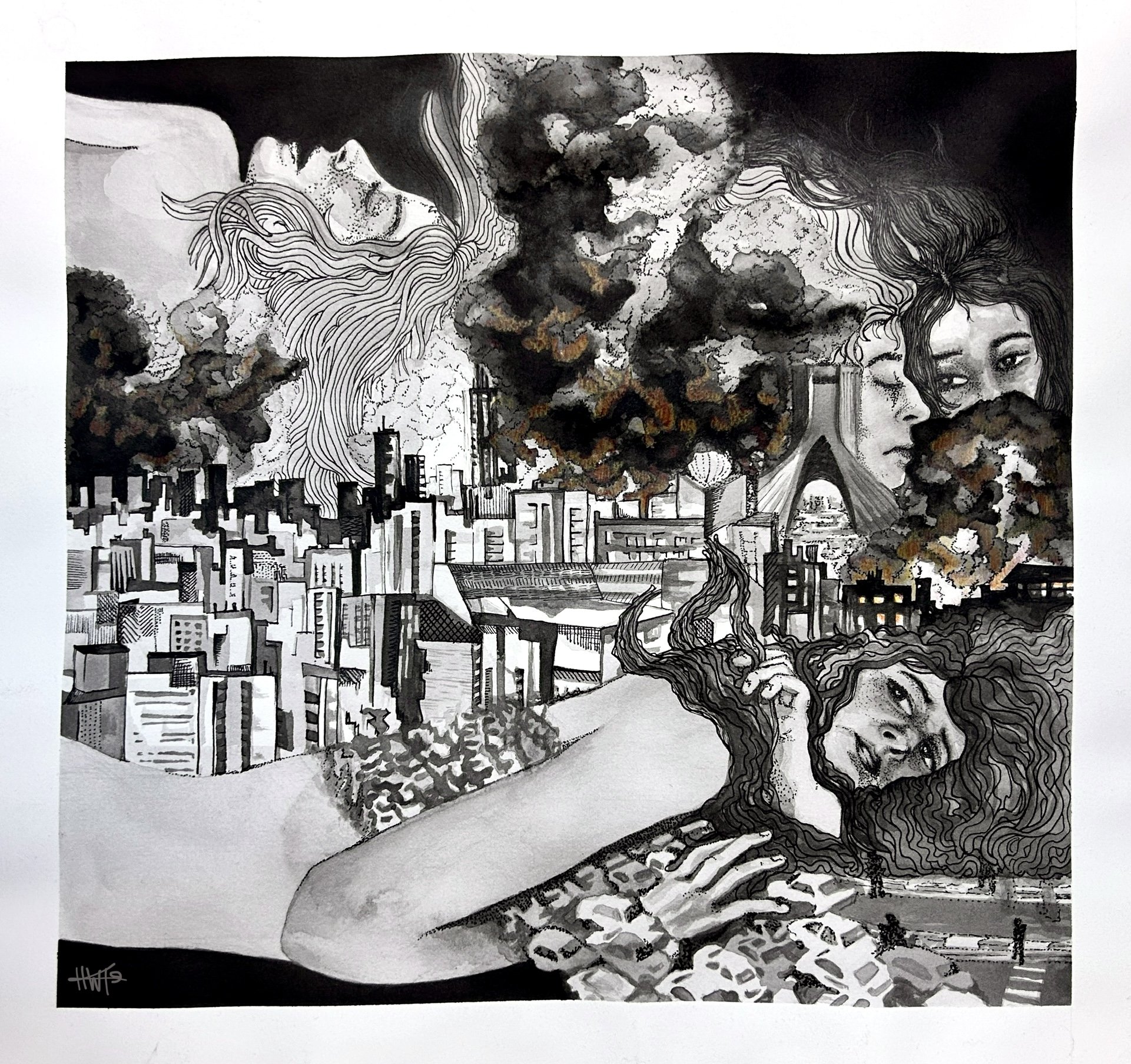
My memories, even the joyful ones, are tied to an unbearable regret—for everything I’ve never known and lost. For an Iran that stretches vast and boundless across my mind, even as it is rendered unreachable by politics, patriarchy, and imperialism. What does it mean if my memories are of an Iran that no longer exists? If the streets I once walked or the buildings that decorated the evening skyline from my uncle’s rooftop have collapsed beneath missiles? What happens when bombs fall on memories that, though fragile and faded, pulse beneath the wreckage of war and time?
“My memories, even the joyful ones, are tied to an unbearable regret—for everything I’ve never known and lost.”
When I hear that Israel has attacked Tehran Pars, I scroll through the images of the damage on my phone, searching for the ruins of my memories. Searching, though I cannot even recall the exterior of my grandparents’ house, not even the color of its front door.
I am always searching, it seems. Recollecting scenes from seasons spent with my family in Iran. Words to songs I sang on countryside hikes with my cousins. The smell of Tehran’s busy summer streets, an oddly comforting combination of cigarette smoke and gasoline. Time and longing rewrite these moments, edit fractured sentences, turning noise into poetry. When it comes to Iran, I cannot distinguish between memory and idealization. The two work in tandem, truths preserved by feeling, to help me make sense of the immense yearning I’ve always felt for my motherland. I ache for past moments, and also for what could have been, for who I could have been. The ache has grown more intense since I’ve become a mother—every memory becomes a landmark on the map to our shared history, which, once complete, can be handed down to my children.
Lately, the desire to recall feels existential, almost compulsive—a desperate need to produce emotional artifacts of a country under threat. I haven’t visited Iran in nearly two decades. I wonder if my sons will ever go. Will my memories suffice in answering their questions or in providing context to their hyphenated lives? When I was growing up, my immigrant parents often lamented the “Americanization” of their four children. As a teenager, the irony of their disappointment—that we had become products of the surroundings they chose for us—was amusing to me. Now I understand the burden they must have felt to preserve themselves in us.
*
Years before my parents immigrated to the United States, my father was dodging military bullets on an unseasonably warm February afternoon in 1979. Weeks had passed since the Shah and his family fled Iran. The country was in an unstable state of limbo when Ayatollah Ruhollah Khomeini, formerly living in exile for 15 years in Iraq and later in France, returned to Iran after the Shah’s escape, drawing crowds of millions to the streets for days. Iran was on the brink of momentous change. Things reached a peak on February 11, the day my father was excused from work early, as the army began to close in on rowdy crowds who had gathered in the streets. “Be koori cheshme shah, zemestoonam bahar shode,” they chanted. “Winter has even turned to spring, the Shah be damned.”
My father rushed home, as radios from shops blared with status updates. He stopped occasionally to take refuge in nearby houses and apartments. “Come in, son,” an elderly woman yelled to him from her front door, as he ducked behind lamp posts and mailboxes. By the time Iran’s military declared its neutrality later that evening, my father had already walked five miles from his place of work in Ekbatan to Tehran Pars. He was four blocks away from home when the sound of bullets died down and the beat of his own heart seemed to grow louder, a hopeful pulse that propelled him the rest of the way home.
My mother, much younger than my father, was uninterested in politics, but she was vaguely aware of the Ayatollah’s promises that things would change for the better, especially for women in the country. She thought the revolution signaled the beginning of equal rights and an end to the policing of women’s clothing. She carried this hope until the Ayatollah announced his plan to implement compulsory hijab. And though she wore it willingly and would have worn it regardless, she sensed the grip of coarse hands around her neck, tightening on some days, loosening on others, but always there. The feeling of suffocation she remembered during the Shah’s reign had returned, but this time, under the guise of something my parents both knew and loved: Islam.
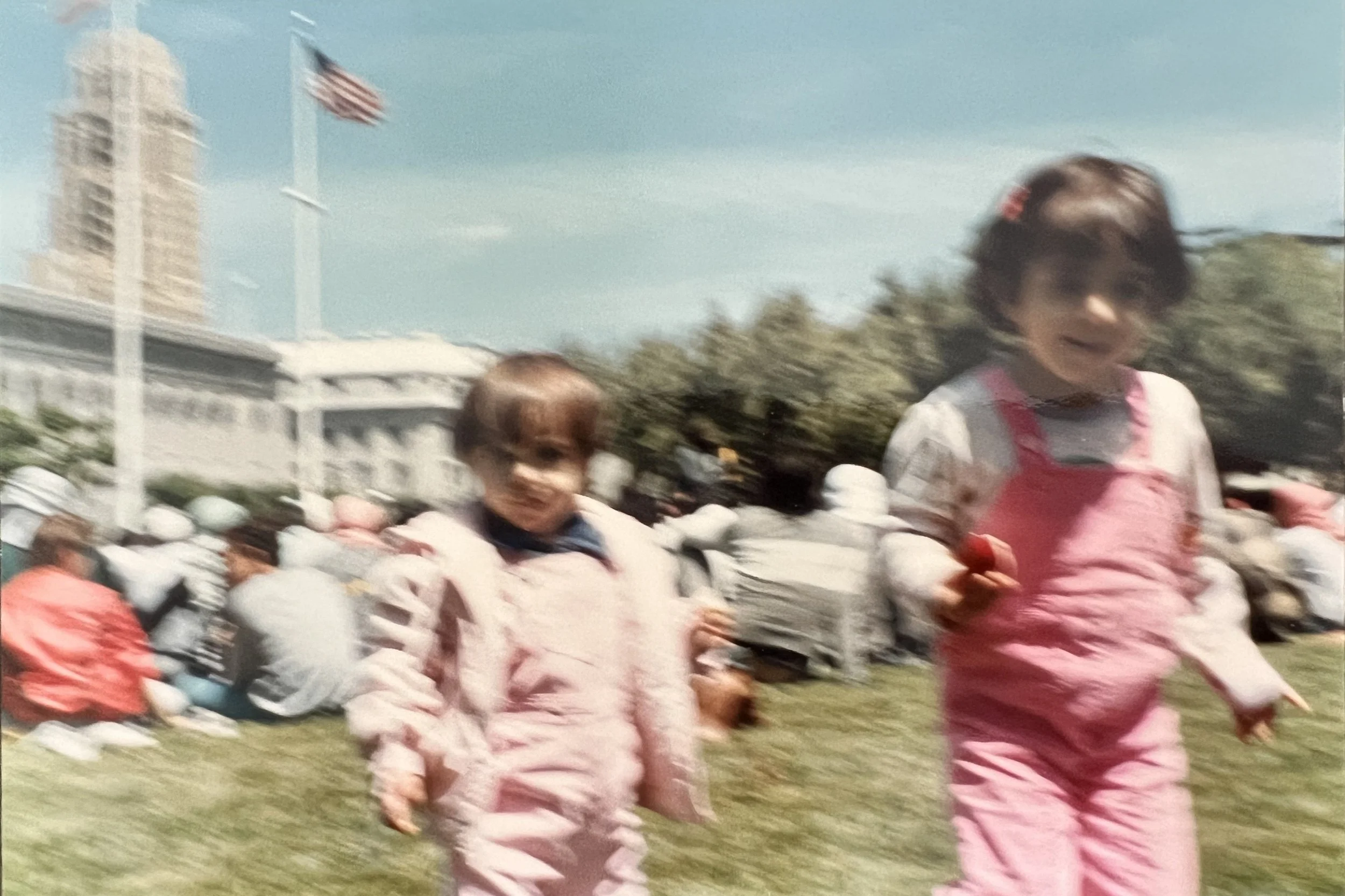
They left Iran during the Iran-Iraq War, a brutal eight-year-long conflict that resulted in the deaths of up to 1 million Iranians, Iraqis, and Kurds. My parents had lived their lives as bombs, many of which were U.S.-supplied, dropped around them across the country. Shortly after they immigrated to the United States, at a time of heightened tension between the two countries, the U.S. Navy shot down an Iranian commercial airplane over the Persian Gulf, killing all 290 passengers and crew on board. My mother’s memory and descriptions of this incident are so vivid, they become my own. A blurry old photo shows us at a protest at Union Square in San Francisco, standing among a crowd of people on a bright green lawn. I am barely two years old, but somehow I remember—or I think I do—the pain vibrating around me. My mother’s outstretched hand beckoning to me out of frame. The weight of a force bigger than us—fear or grief—passing from her fingertips into mine.
My mother and father moved carefully in America, as if the ground might crack and give way beneath their feet. In public, their voices were hushed and their bodies turned slightly inward; they seemed always prepared to brace themselves against a threat. Our everyday lives were enveloped in a fragile secrecy around my parents’ unrealized success and unstable documentation status. My mother and father were private and guarded people, I thought, not realizing that these were traits they had adopted in order to survive.
Then, during our first visit to Tehran, I watched my outwardly reserved parents transform in front of me. They joked and shared stories with their siblings, they spoke Persian in local accents. They loosened and relaxed, became aloof, forgot about their children and where they left us. They grew unburdened and free. They laughed harder. They cried openly. They were themselves, I learned. I wondered whether I ever knew them. And how deep the chasm of misunderstanding between us would have grown if we had never visited.
*
One spring, when I was a teenager, my family and I visited Iran to attend the memorial commemorating the anniversary of my paternal grandfather’s death. The entire village of Ruteh seemed to come to a standstill for him. Farmers and shopkeepers stopped their work when they saw my father and his siblings in the street. They put their hands on their hearts and expressed their condolences, sharing memories of my grandfather’s generosity and compassion. At the masjid ceremony, surrounded by a sea of unfamiliar faces, I tried to balance my awe at the life my grandfather lived, with my grief for a relationship I had never known. I remembered only a single brief conversation he and I shared when I was a child: me, digging my fingers into the pile of the living room rug at the Tehran Pars home, tracing the pattern with my eyes. Looking up and realizing my grandfather and I are the only ones in the room. He, drinking tea with a sugar cube in his mouth, lazily sucking on it like candy. I straightened up and smiled. In his regional mother tongue of Gilaki, he asked me a question I did not hear. “I’m sorry, what?” I replied. “Ayaal namfahmeh,” he said to no one, the child doesn’t understand.
But what I felt was more than a simple lack of understanding; it was an inability to hold the emotional weight that came with it. I needed space to process the sadness that seemed to douse the beginning of every visit in gray, when the awareness of all that I had missed began to set in. I struggled to accept the devastating reality of the fleeting nature of time. During each trip, I’d notice my cousins, children turned teenagers turned adults who now wore makeup and tight-fitting manteaus, and I felt frozen in my heartache, in my realization that our parallel lives would never intersect. I was a visitor to their world and to the person I was within it—someone both familiar and strange, struggling to revive hidden parts of herself that had long atrophied.
During that spring visit to Iran, the Persian New Year had overlapped with the Holy Month of Muharram and the people were in a curious state of celebration and mourning. The country’s Persian and Shia identities seemed locked in a friendly game of tug-of-war, the streets pulsing with contradiction. Drums and chains of grief beating in Ashura processions, alongside the scent of sabzi polo and the brightness of haft seen spreads. Joy and sorrow existed side by side, neither canceling the other out. I felt what it was to be two things at once, and the contentment of not needing to make sense of it, or choose.
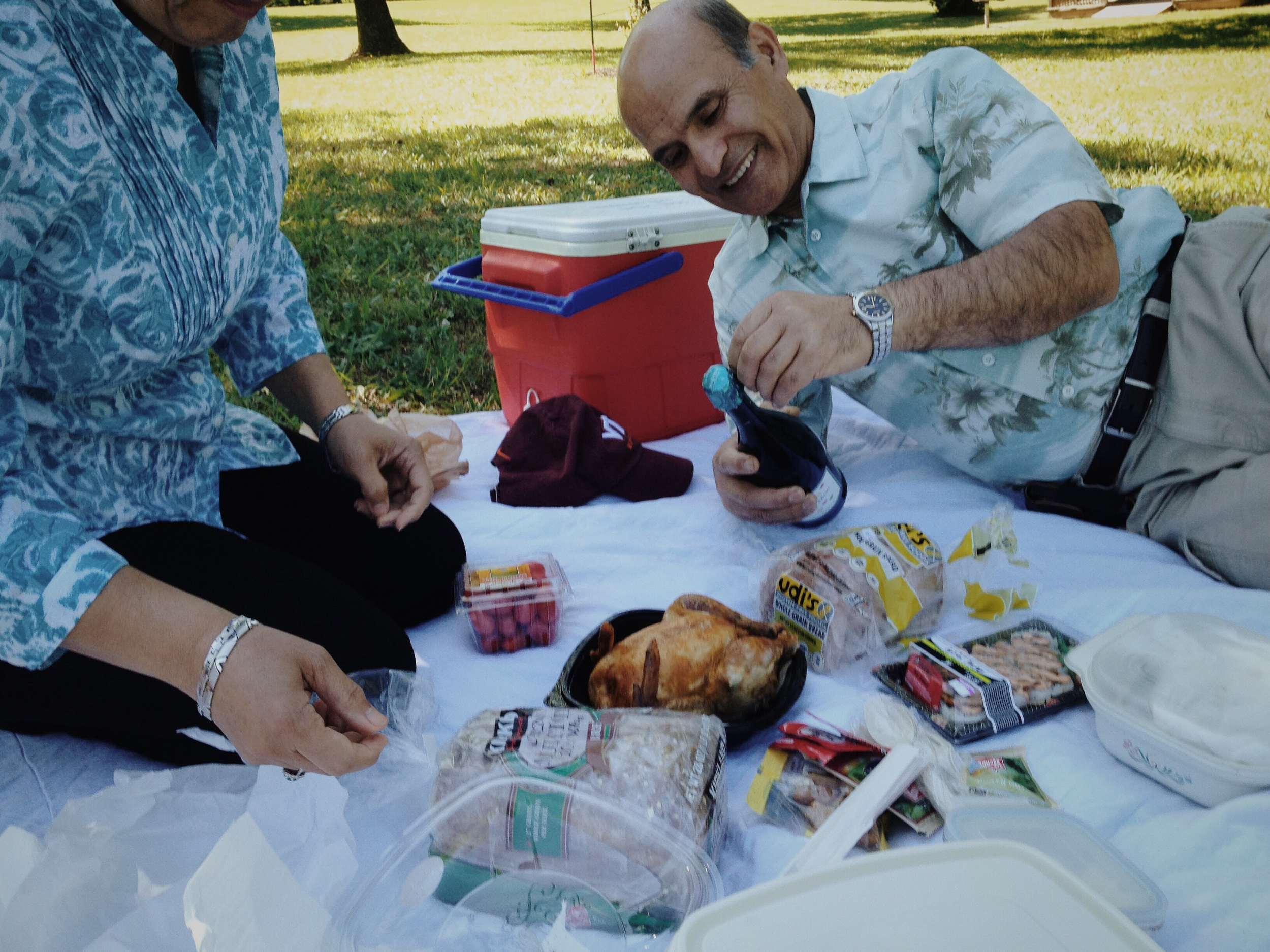
On the 13th day of the new year, sizdeh bedar, tradition dictated that we celebrate outside, picnicking in parks, walking in nature, and breathing in the open air. But Tehran woke up under a gray sky, heavy with rain. While most of our family chose to stay indoors, my cousins and I packed some snacks and walked through the wet, shimmering streets to Azadi Square, where the city’s Freedom Tower stood proudly in the center. The wind whipped around us and we laughed as our scarves loosened. Around us, there were no crowds or fanfare. Only the four of us, soaked and basking in a feeling older than time.
*
I recall the past to untangle the present, to understand how glimpses of possibility and promise can be muddied by forces outside of our control. I recall the past to imagine a different kind of future, one that feels rooted in the bittersweet nostalgia of an Iran that lives in my mind. There, even romanticization becomes a kind of truth, an emotional blueprint of the home—the safety, comfort, and belonging—I want for my children.
The United States entered Israel’s 12-day war against Iran while I was putting my son to bed. He, in a restless sleep next to me, conjured a new memory, one I had forgotten. When I was nine years old, my family and I took a weekend trip to my father’s childhood home, a modest farm house tucked into a hill in the village of Ruteh. We arrived late in the evening and, though it was the middle of summer, the air felt crisp and cool. Inside, my cousins grabbed blankets and cushions and laid them on the balcony overlooking the mountains in the distance. I had never seen a sky so black or stars so bright. The darkness surrounded us like a cocoon, yet I felt dangerously exposed. My aunt stepped out and sat with us. “Do you want to hear the story of a jinn I saw out in those hills?” she asked with a playful smile, pointing to a faraway light that flickered feebly behind some tree branches. We inched closer together and nodded.
I’ve forgotten the details of her story, but I remember what I felt as her words curled around us. A new kind of fear, not of ghosts or monsters or jinn, but a creeping sense that the world was bigger and stranger than I’d ever realized. I felt suspended between curiosity and apprehension, unsure of whether or not to ask questions that likely had no answers. I remember that there was no clarity or catharsis at the end of her story. I remember I didn’t sleep that night.
The next morning, the sound of my children watching cartoons draws me out of bed. I drink my coffee on the couch next to them and I remember breakfasts in Iran. Sweet hot cardamom tea, lavaash, feta, and my grandmother’s homemade sour cherry compote. My cousins and I would eat in front of the TV, which was usually playing a Persian dubbed Japanese cartoon called Futbalistha. Iran is bombed as I remember this scene, grief spilling into the cracks of my memory. My children laugh at the television. Now, too, there are questions I do not want to ask—about what will happen to the family I left behind, to the country I can claim only in parts and pieces. I shift closer to my children on the couch, making room for my memory to move through us, real yet intangible, like the air we breathe. I hope it will one day lead them beyond the elsewhere of my stories, beyond the limits of my remembering—to Iran itself.
Elham Khatami is the editor of Kucheh Nameh. She has previously served as a journalist and editor at ThinkProgress and CQ Roll Call. Her work has appeared in Catapult, WIRED, Guernica, and other publications.