Her vanity was a three-sided mirror built into a wall. I’d climb on top of her cloth covered vanity stool, get myself in front of those mirrors, put my forearms down on the tabletop full of what seemed like world's most amazing gems—lip colors and hair-pins, snow globes, souvenir jars and yesteryear’s shimmering eyeshadows and the impossibly beautiful tin cans of Japanese powdered blush—then I’d look to the left to watch myself repeat infinite times, and then I’d look straight ahead peeping to the right, considering the serial copies of myself, repeating down a long tunnel, each one fainter, each one farther away.
The vanity took center stage in my grandmother’s large dressing room. Floor-to-ceiling storage closets custom-built of thin panels of heavy wood painted an overcooked asparagus green. The door of the closet to the right of the vanity made a high-pitched creaking sound when opened and had shelves with orderly rows of items no longer used, yet never tossed. Cans of Tuft; eyebrow tinters; square boxes of hair root coverup wax in amazing shades, even blond; dried sticks in etched gold cases; long-lasting lip stains in rose printed tubes; perfume flacons with oil-stained atomizers; vintage used and new boxes of powder; blue and yellow synthetic American cotton balls and nail polish remover. On the third shelf from the bottom lived the vast depository of her nail enamels—from orange and mauve, to Spanish red and crimson, to shiny creams and pale beiges, purples and violets, and even hot pink. All mostly bottles of rotten enamel thick with time, murky oil standing above, heavy pigment sunk below.
The rest of the closets contained what seem like centuries, but only decades of life—cashmeres, ball gowns, ski clothes, capes, hats, wigs, costume jewelry, and now-futile diamond sets, a collection of handmade fans from different corners of the world, and a random host of other things.
As a young girl, I used to believe one could find anything in her wardrobe, from fine fabrics, and interesting buttons, to silver cutlery, boxes of scented Yardley soap, tin cans of mink oil for the shoes, back-up Nescafé, domestic sugar cubes, and cooking oil. She had traveled through communist China in the mid 1940s. In their home, she and her husband had hidden intellectuals, their friends, who were fleeing the torturous hands of SAVAK. She had traveled to Europe and had been all over America well before my birth—from Coney Island to the Grand Canyon. Still, in all her years, she must have known only a few seconds, if that, of freedom. She grieved the economic, political, and religious inequalities that surrounded her. She was familiar with abundance and scarcity. She coped with a life full of different rounds of oppressors. She had worn, then put away, the frocks and gowns without looking back. She now wore brown Islamic code matching subsidized uniforms, roopoosh o shalvar.1 Hidden behind the entombed gowns, as her mischievous grandchildren would come to discover, stood two tall glass jugs of wine from a gone age—an era petrified behind the inevitable eruption of history.
The revolution came in 1979, but then Air France ushered in Khomeini, who would forbid both my grandmother’s wine and the hopes of her leftist husband, my grandfather Ardeshir, for a better Iran. At first they took her—a Zoroastrian woman who owned some land and lived in a big house alone—and put her in Evin prison for some 140 days. Surely, they were hoping to scare her away. Then in January 1983, they arrested her son-in-law, my father Babak, a Fourth Internationalist leader,2 and kept him in that prison for six years and two months of our lives. Soon after Babak’s incarceration, Ardeshir, who was by this time in New York City and very sick with Parkinson’s Disease, took his own life. In all those years, she watched her only daughter among four sons, my mother Kateh,3 a revolutionary in her own right and the organizer of the Women’s March, the first and only celebration of International Women’s Day in Iran (on March 8th, 1979), sentenced-by-circumstance to a parallel life of loneliness and resolve. My mother and grandmother who lived a few Tehran neighborhoods apart, worked hard, preserved composure, and kept life going despite the pressures of domestic persecution and the horrors of the imposed war.4 My grandmother, who stayed and kept her green vault. My mother, who eventually saw no choice but to leave, and has no trouble emptying closets.
My closets are abundant like my grandmother’s. Not merely as a need, but as the only way to stay connected to what was and what could never again be. Among my many treasures, from seashells and souvenirs, to ribbons and postcards, I also keep some of her knitting tools, uncut fabrics, statuettes, clothes, hats, scarves, one of her now out-of-style crocodile purses, some of her shirts, a pair of her shoes, her handkerchiefs, the long paisley dress she wore to my uncle’s wedding in Paris sometime in the early 1970s, two Jaegar suits (one in burgundy another in navy blue), the last polyester shirt she had on, her last beige bra (the one they sent home from the hospital in a plastic bag). I’ll sometimes wear her sleeping gowns, most often the one made of thin light blue fabric with delicate embroidery. I keep some of her fur coats, and I treasure the pre-war Desdemona Wet Towelettes she had given me, to keep in my bag for fresh hands, by locking them up in a safe.
There is no war where I live now, so no need to hide the black market coffee and rations of sugar and oil. I am only 24 years old, and in a far earlier stage of life than she was when I knew her. In my closets, I do not keep hanging rows of silk ties, suspenders and a box full of cufflinks that once belonged to a husband long dead behind the sandbanks of time. I have no need for the decades of tailored suits, ball gowns, brooches and wigs, opera gloves, nylon lingerie and bathing suits fitted with cones. That way of life, along with the era’s glamorous pin-up silhouettes, are nothing but faded relics behind summer’s gone. The people of my childhood and their stories have all but vanished, some artifacts may still remain, affirming fragments of a past, at first archived inside familial closets, then slowly removed to flea markets and onto landfills beyond.
My grandmother, whom we called mémas,5 drove around town like Cruella de Vil. Fast and unconcerned as she raced down the streets of Tehran, changing lanes and gears on her silver Peugeot 504. Honking the car’s loud horn when she came down our street, formerly named Kuché Babak Gharbi and later changed to Kuché Shahid Nasseri,6 to pick up the three of us––me, māmān, and baby brother.
She would never come upstairs, rarely rang the bell, just honked her signature triple horn twice, beep-bee beep, and we'd start heading down the stairs. We lived on the top floor and we sometimes took the elevator, but in those days you’d never know when there’d be a power outage, so it was best to use the stairs at least when going down. Why was she picking us up today? To do what? Were we visiting someone? Was it a Thursday Kabobi family meetup? A delicious Monday lunch at the Montazemis? Time to visit our dear aging Khalé Banoo? Or time for a stroll in the white Ma’bad on the first day of Spring? The Ma’bad7 that looked smaller than her, and smaller than her house, that for her stood apart from deity. A place she respected as a sign of our existence, a building holding both Zoroastrian heritage and a simple, yet most often overlooked, belief in good thoughts, good words, good deeds8.
Racing down Bijan Street for a quick visit with Khalé La’l, onto Maydan Argentine for another quick stop to say hello to her eldest sister Khalé Farangis, then a stop at the bank before finally turning down Seoul Street to home, Kuché Yekkom. That house is no longer, and neither is the alley.
The warning signs are not always easy to detect. A seemingly minor weakness in the arm, leg, or face, a headache, loss of vision, or dizziness can be signs that something, that something more, is terribly wrong.
Such was the case with my mémas. They said she was having chai o khorma, sitting there at some poor old guy's funeral whom she didn’t even know, held her head, and said “akh.”
She then leaned her head back on the chair and went away forever. I know she was 83, I know that she would've died sooner, not later. It's just that she was a love so unexplainably vast, yet so concealed, it felt like a secret. My secret scent, my secret wonder woman. My secret truth teller, my secret myth-buster, my secret storm at bay. The secret of slipping cardamon pods into black tea; the secret of freshly plucked jasmines in a brassiere; the secret of worn strips of rags binding unruly toes; the secret of command over herds of wild dogs. A secret hatred for liars; a secret distaste for cigarettes and also cats.
Just like her closets, and her manner, her home too held many secrets. There were lithophane porcelain sake cups out on the living room shelf. Fill them up with any liquid and a nude Japanese woman appeared under the cup’s bulging glass dome. She owned many stale towels that would never dry the body. Once a year, moths rose and sat on her bedroom’s lace curtains, a phenomenon for which there was always a box of pistachios to blame.
She had a heavy drawer of cassettes with handwritten titles next to her bed. A couple of them were old joke tapes that she’d sometimes play for herself. In the afternoons, she liked to listen to Banan9 by herself, in the evenings Golha-é Rangarang10. A medicine drawer to the far left corner of her room sat bursting with untaken remedies. Hung near her bed was an ominous painting of a woman with a bent head wearing a full skirt. The mystery woman with bare shoulders is clutching a shawl standing in the dark end of a dimly painted room.
She had a hodgepodge of pillows on her bed, none matching the other in cover or size. A small one covered in burgundy silk that she had made herself was the pillow I loved to hug most on nights when I slept in her bed. Soft and cool, the small pillow brought me a sense of ease on otherwise charged, uncertain nights. The little pillow that, like a dream-weaver, lifted my worries from my limbs until I was light enough to float up into the air, and sink into sleep.
I went to her on an especially cool summer night with an especially light suitcase in one hand. Three strokes, the loud sound of metal, on a tall green door. TAA—TA—TAA. The qanat running down the side of the long asphalt driveway fresh as a river, at the beginning of all things familiar. The smell of raw milk brought from the farm at Saïd Abad to the city on Wednesdays. My small hands holding the funnel while the farmhand pours silky milk from the churn into waiting containers of family and friends who have stopped by for their weekly pickup.
Passing through the garden’s cobblestone path, I am a woman now arriving at empty drawing rooms. A sudden surge of warmth spreading through my body. A few steps back behind the front door to recall the grease-filled grooves of the dummy brass door handle, pushing open the heavy wrought iron glass panel one more time, making my way through her hallways, eagerly aching to see her, too scared to call out her name lest I should be met with silence.
The house standing vast and endless before me. A deep red rug with lapis swirls of Isfahan melting into the smoke blue velvet of armchairs, gray cobblestones pulsing beside the carpets, black asphalt switching places with mulberry leaves right beneath my feet, changing hues correcting the palate of surety, pushing open the entrance door with my palm over and over and over again. Razed rooms rising by the insistence of memory and a wishful mind in sleep.
How all the joys of spending another summer in Iran—the marvelous prohibited parties, excursions, flirtations and crushes—are reduced to a need to get off this airplane right now to only be with her. I hear the sound of her radio blaring in her room. I am standing right outside her bedroom door, and from there, I can see her sitting on her bed looking down at her hands. I am then moving in a car north, away from the airport, traversing through Tehran’s deserted freeways, making my way to Vanak. I begin to worry I shall never get back to her house.
I see mémas in her old nightgown of blue daisies, her toes carefully wrapped up. She asks if I want to go upstairs and rest a bit. I am tired from the travel. I see now, she is organizing her box of leftover yarns.
How can I close my eyes to sleep now? But one must be very careful, the earth woman never trusts too much attention. She is suspicious of too much love, she will pull away and dismiss it as cunning flattery.
She’s pulling on her government issued Bazaar-é Ghods11 matching roopoosh o shalvar. She’d remember her head scarf this time. She’d storm out of the door, lawyer in tow, for some more dealings with governmental men who keep taking what’s hers. Self-administered B injections to make her strong before running out again. She is ready to fight. She is ready for more meetings that lead to nowhere. Me, only a child, spectator to the busy life and world of this most peculiar woman.
I wonder where she’s disappeared to and go looking for her, only to find she has retreated to her bedroom, using the afternoon cleared for receiving a special guest to instead organize her plastic bags drawer.
"Nemiyay paloomon?” Won’t you come back to us, I plead.
"Nah,” She’s quite decided.
She tells me the visitor, our special guest, talks too much nonsense, bringing up “khoda o peyghambar,” God ’n’ Prophet. She’s offended by faith. I marvel, I give a low hum.
What about that time when she makes her entrance into the large living room, all the guests sitting around the hall of damasked wallpaper and crystal chandeliers. Our stately lady stepping forward to greet each guest like a Lord, standing tall, dressed perfectly in an old dress, her obvious breasts pointing forward, her long hair gathered in a bun. She greets the first guest, then the second, all the while a very large cockroach seated on her shoulder. Her eldest son, my Uncle Kasra, rolls up a newspaper and whacks the cockroach down before she can greet the hands of the next guest. She moved as in a dream, and tales of her now sound like legends.
A grandmother, but also something more—the balance, the fixed point one can return to with every turn. Like the spot and the point the ballerina picks and sews her eyes to, always holding on to it quickly, quickly after the return from each revolution. The point, like her, which can be anything at different times, but is always really the same thing, the stillness inside the spin.
What went on in her head? Did she keep a diary? Oh, I wish she had. Did she have any loves other than our grandpapa? Did she love sleeping under the sky? Is that why she set up the beds with mosquito nets for us on the roof every summer? Did she really abhor cockroaches, but acted nonchalant to toughen us up? Was she really the first woman in Tehran to drive? Did she think it was sick to be obsessed with one's children? That it was sick to not let one’s children choose what they wanted to be and do? Is that why she let them all go, even though she really wanted us all to stay?
Sometimes I walk into a place and I’m not sure how to stand or what to do with my body, then I recall the sight of her marching into the oppressive room of the local Kalantari,12 carrying her unalienable rights above her shoulders, in the depth of her eyes, with the skin of her teeth. Her hard belief in the rights of all people, woman/Zartoshti/other, shaking the stone tiles under the gentle steps of her disfigured feet, forcing the most ruthless of rights deniers to rise in respect. A woman with a name, from a time in the 20th century, with closets full of real and fake jewels, uncompromised and compromised truths, becoming a memory long after her death so that we can stand tall. Men with beards in roles of authority, behind their metal glass-top desks at the local police precinct, men unwilling and unable to interact with a woman, men who through all her pleas and petitions never helped, now jumping to their feet at the sight of mémas, at the sight of a woman who never gave up, now bowing their bewildered heads invoking her name:
“Khanom-é Vafadari”
“Befarmayid khanom-é Firouzgar”13
“Befarmayid khanum-é _________”
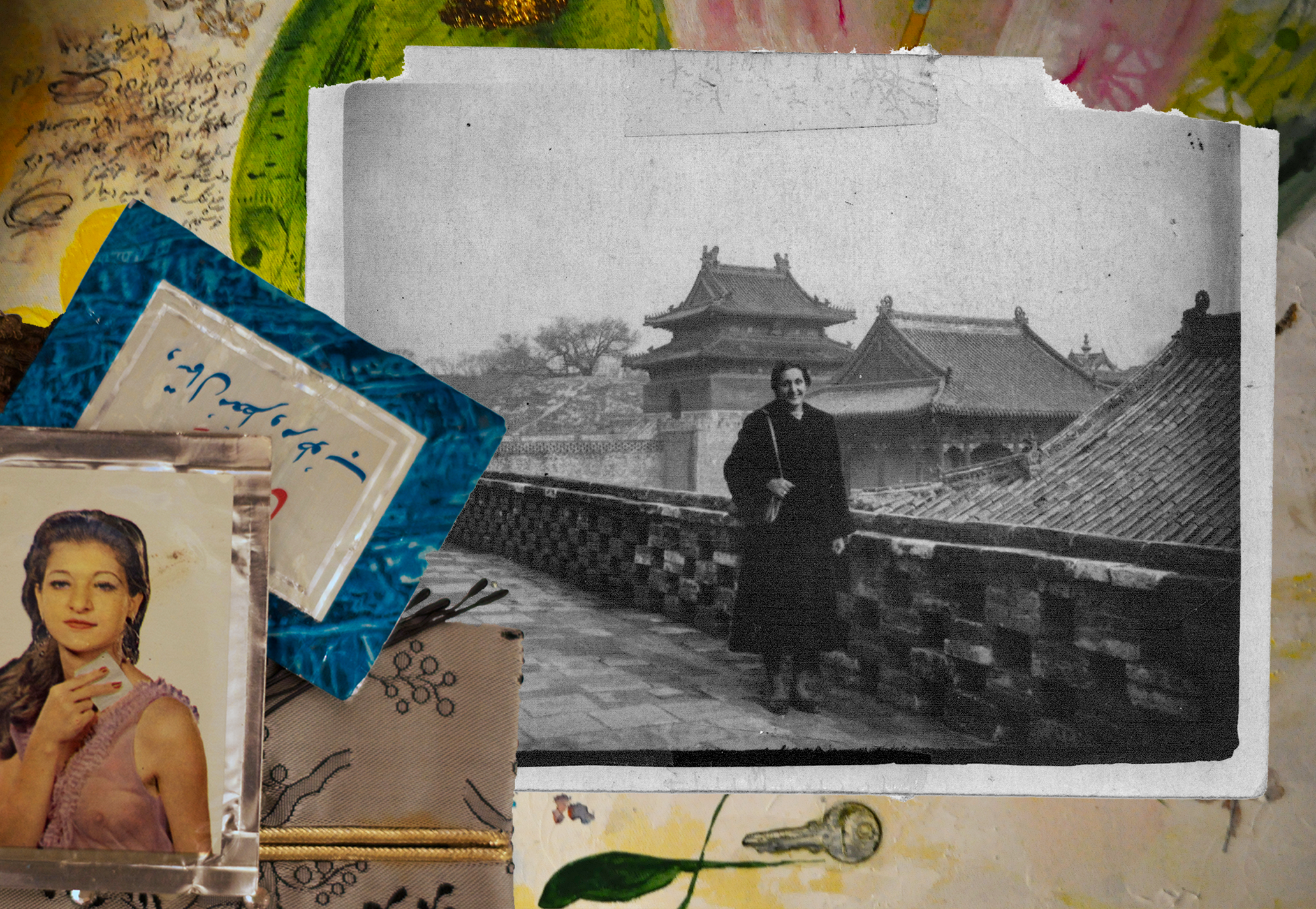
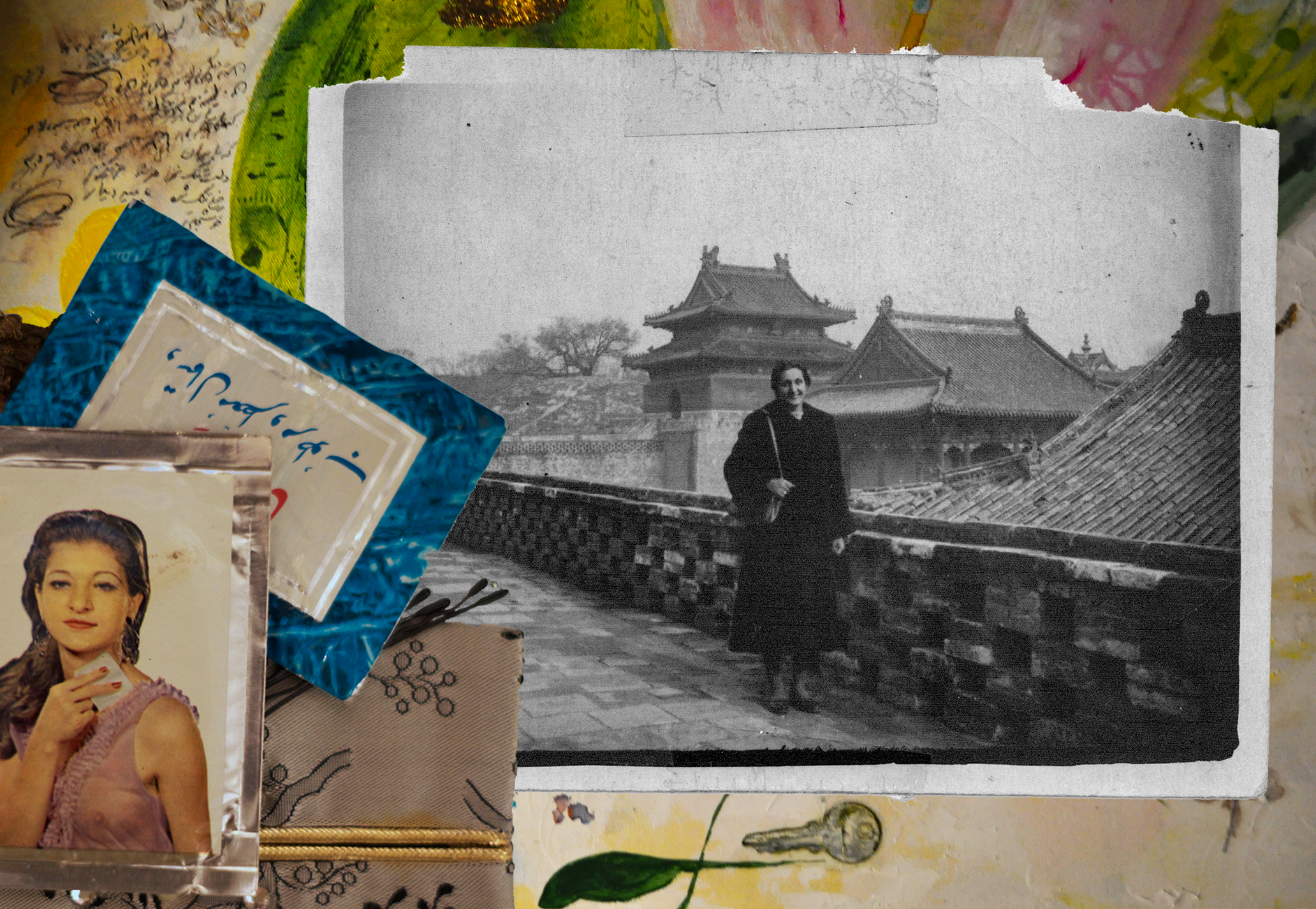
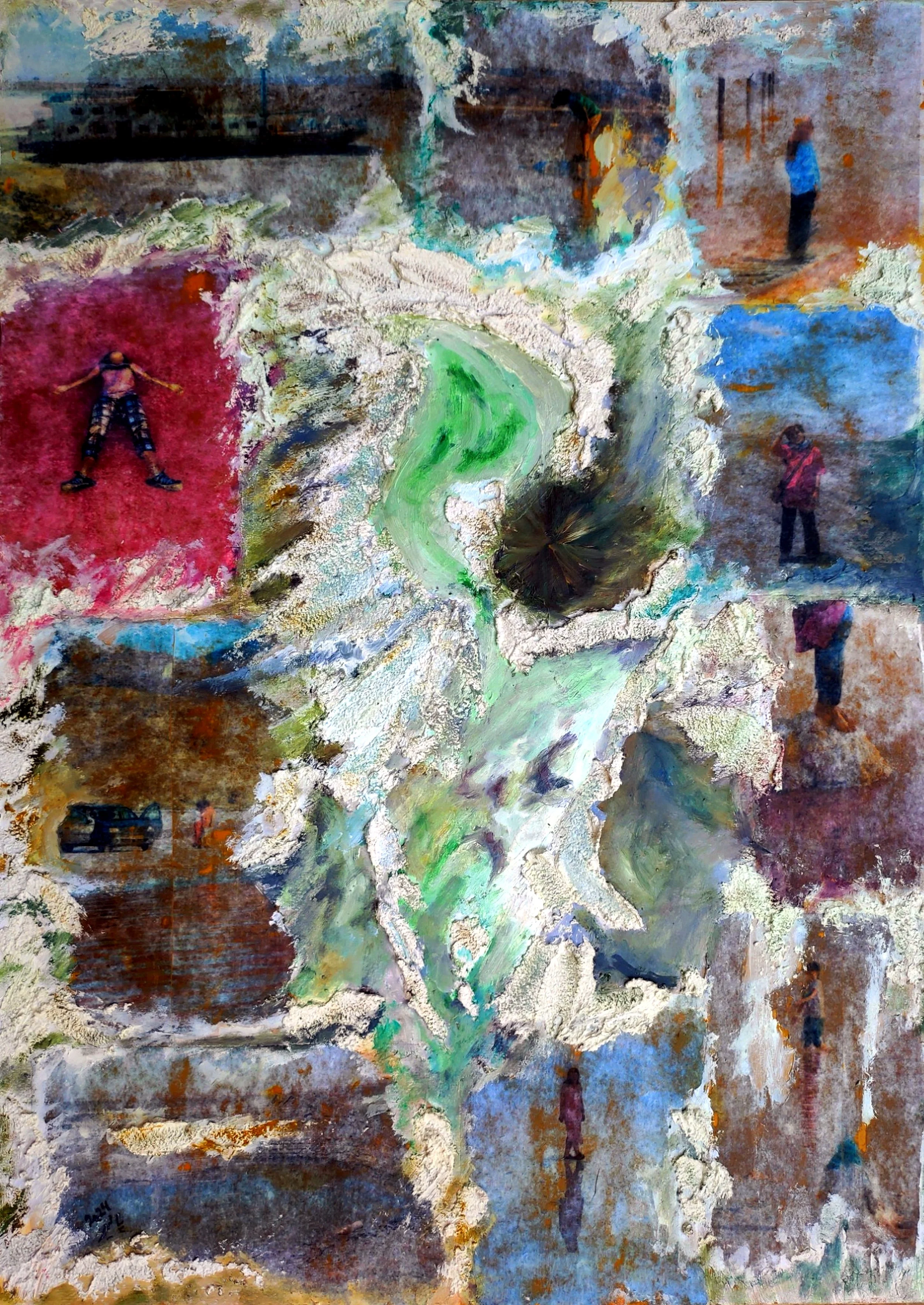
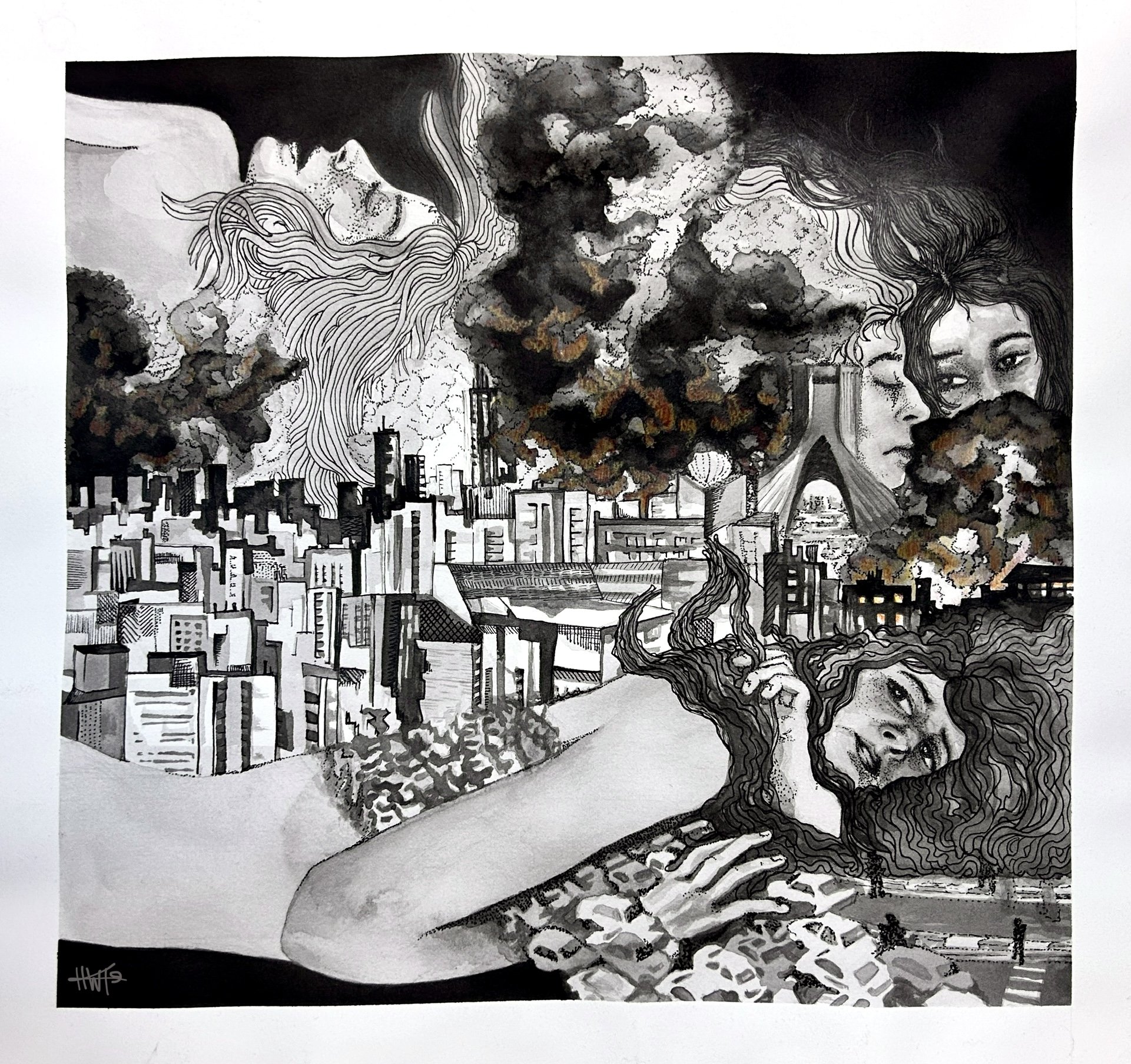
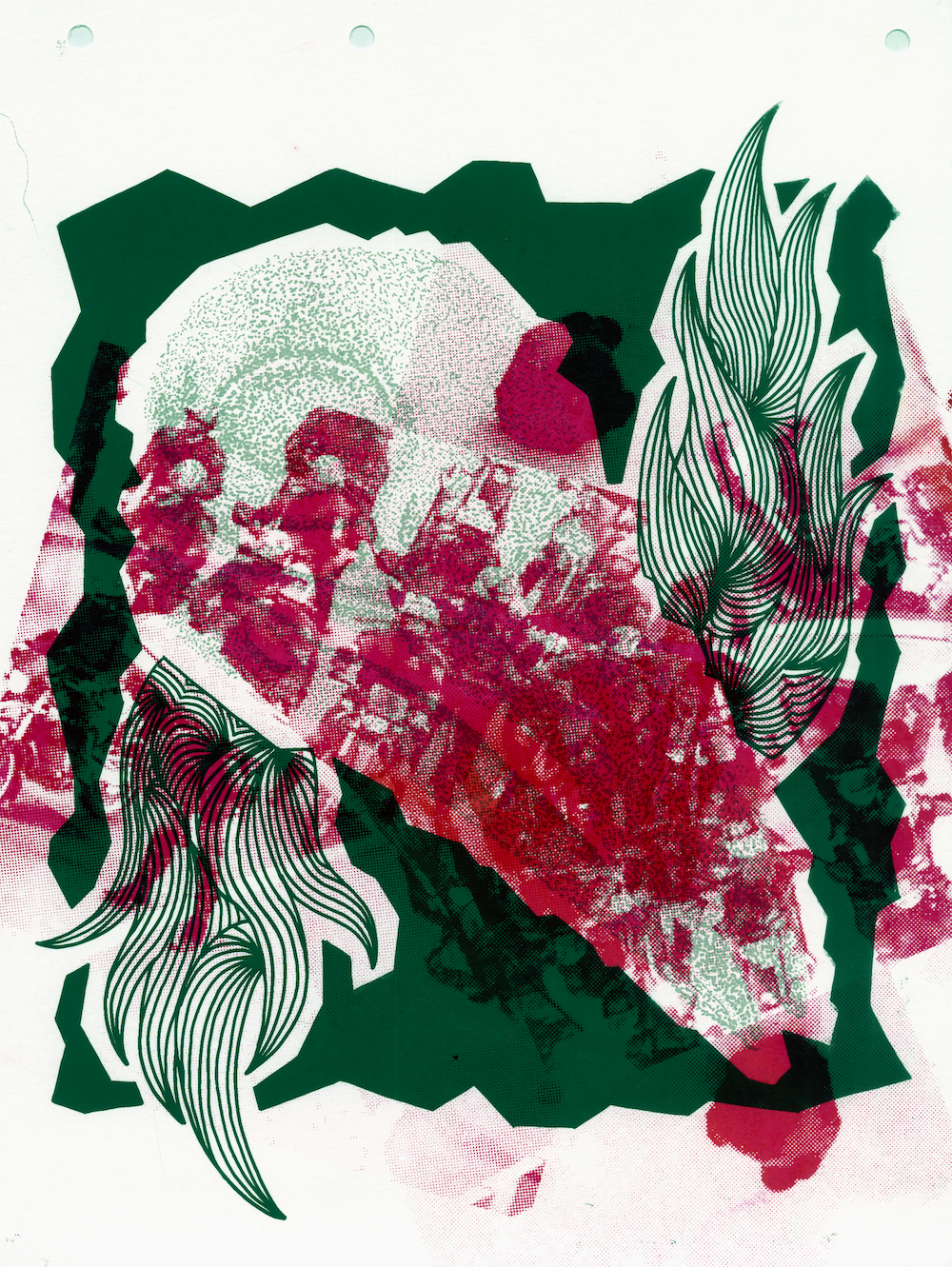
delat tang nakhahad shod (2026), by Neda Zahraie | Mixed Media Collage
1 roopoosh o shalvar (or manteau o shalvar) a matching pants & manteau (long coat) uniform for women, up to Islamic code, worn primarily in government buildings and public institutions, especially in the first decade of the establishment of the Islamic Republic. At the beginning of the Summer of 1980 (15th months after the victory of the Iranian revolution) Iran’s Revolutionary Council decreed that women without Islamic dress were not allowed to enter government offices.
2 The Fourth International was a Marxist political international established in France in 1938 by Leon Trotsky and his supporters, having been expelled from the Soviet Union and the Communist International. Trotskyists worked in opposition to both capitalism and Stalinism.
3 Kateh Vafadari headed of the Ad Hoc committee, the Committee to Defend Women’s Rights, which distributed information and held meetings in post-revolutionary Iran discussing women’s rights. She was a key organizer and spokesperson for the March 8, 1979 Women’s March in Tehran. At her invitation International feminists including Kate Millett (1934-2017) travelled to Tehran to support Iranian feminists in their fight for equal rights.
4 In Iran, the Iran/Iraq war (1980-1988) is often referred to as, jang-é tahmili, the imposed war.
5 mémas is Zoroastrian Dari word for grandmother
6 After the 1979 revolution many of the streets were renamed, especially in honor of men who gave their lives during the Iraq/Iran war. Shahid (trans.) martyr.
7 Atashkade-ye Adrian (Adrian Fire Temple) referred to simply as ma’bad by members of the Zoroastrian community is Tehran’s primary Zoroastrian temple, a registered National Heritage site.
8 The three central tenets of Zoroastrianism Good Thoughts, Good Words and Good Deeds (Humata, Hvarshta, Hukhta in Avestan language) form the ethical core of the religion and emphasize living truthfully, compassionately, and responsibly through thought, speech, and action.
9 Gholām-Hossein Banān (1911-1986) was one of the most prominent Iranian musician and singers of the 20th C. renowned for the quality of his voice.
10 Golha-yé Rangarang Trans. 'Particolored Flowers [of Persian Poetry and Song]', the series was produced as part of The Golha ('Flowers of Persian Song and Music') radio programs that were broadcast on Iranian National Radio between 1956 and 1979.
11 After the 1979 revolution, by order of Ruhollah Khomeini, 14 Kourosh Super Stores originally founded in 1970 were confiscated and placed under the control of the Foundation of the Oppressed (Bonyad Mostazafin) and renamed Bazaar-é Ghods, which in the 1980s provided the population with affordable, low quality, domestically produced and subsidized everyday essentials. Gradually, the stores were divided into individual rental booths and leased out, eventually turning into something resembling mini-malls, until their final closure due to bankruptcy by the turn of the century.
12 kalantari, a local police station
13 Mehrangiz Vafadari (née Firouzgar) (1920 - 2003) born in Tehran, died from sudden stroke while visiting family in the Washington D.C. area at the age of 83. She was one of the 7 children (6 daughters and 1 son) of the prominent Zoroastrian family of Goshtasb Firouzgar & Homayoun Afsar-Keshmiri. Her father Goshtasb built “Firouzgar Hospital” (1953 - present) the biggest and most modern hospital at the time in the best part of Tehran, and donated it to the Ministry of Health, with only 3 set conditions: that the hospital should provide free care for all; that there should be a member of his extended family on the Board of Administration; and that the hospital should provide employment to any Zaroastrian if he or she had the same qualification as any other candidate. Mehrangiz worked as a midwife for 35 years serving underprivileged women, and served on the board of Firouzgar Hospital until her death.
Neda Zahraie is an Iranian-American writer, translator and multidisciplinary artist. She holds an MA in English from the City College of New York. Her poetry has been published by Epoch Press, Chant de la Sirène, OyeDrum and Promethean. Her original music recordings include, Red Lips by Kamalata (Apama Records 2016) and Freedom by CHIC CHOC (2023). Her hybrid work of poetry, Anamnèse, a 22 part collection of poems and paintings, highlights the limitations of memory and the impositions of nostalgia on the female body. Anamnèse was staged at Rattlestick Theater in Manhattan (NYC) as part of Emruz Festival 2022. Neda is the founder of the weekly Tuesday night reading series at DADA in Ridgewood (Queens), and is a founding member and editor of the intersectional feminist magazine OyeDrum. In 2026 she established Vulture Culture Press, a print-based press dedicated to poetry, prose, and hybrid experimental literature in NYC.